APS Publications![]() Fluid Landscapes and Human Adaptation:Excavations on Prehistoric Sites on the Lincolnshire Fen Edge 1991-1994
|
| View Publication Details |
Edited by Steve Malone and Mark Williams
Heritage Trust of Lincolnshire 2010
ISBN: 978-0-948639-49-4
RRP: £10.00 plus £2.50 P&P
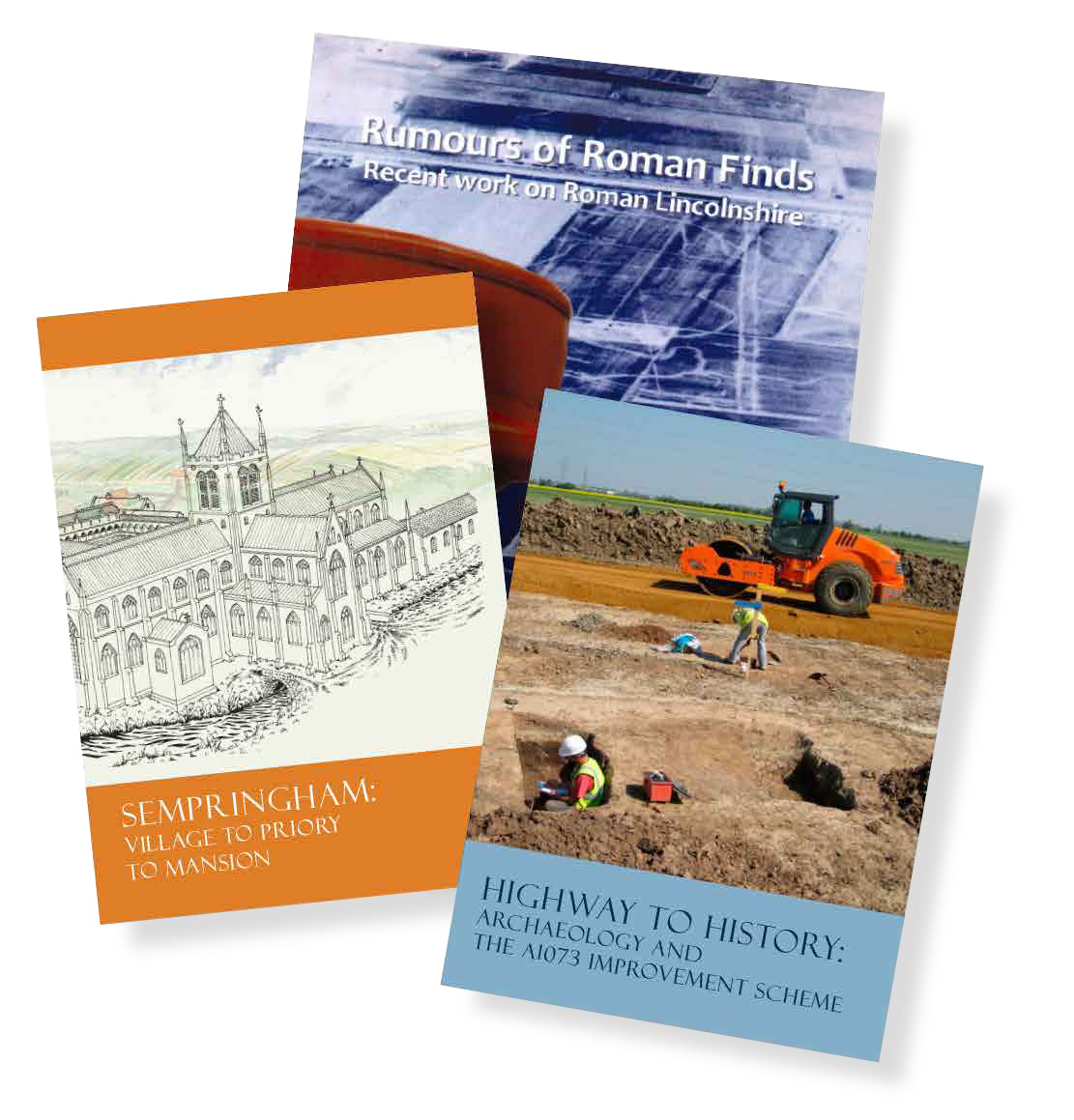
This volume arises out of the Roman Lincolnshire conference organised by Mark Williams (then of APS) and held at the University of Lincoln on 25th June 2005. Contributors on the day were Chris Clay, Mick Jones, Steve Malone, Ian Rowlandson, Mark Williams and Sally Worrell standing in for Adam Daubney who was unable to attend. The papers in this volume are based on their contributions (or intended contributions in the case of Adam) supplemented by a number of further pieces on sites within the county which deserve a wider audience. Publication versions of papers were largely produced during 2006 with some later additions; those of AD and SM particularly have benefited from the opportunity to update to 2010.
Contributers:
- Tom Bradley-Lovekin
- Chris Clay
- Adam Daubney
- Neil Herbert
- Dr Michael J Jones
- Tom Lane
- Dr Steve Malone
- Vicky Mellor
- Ian Rowlandson
- Brian Simmons
- Gary Taylor

Review and assessment of all data relating to this 92km-long Fen Edge watercourse.
| View Publication Details |
Lincolnshire Archaeology and Heritage Reports Series 8
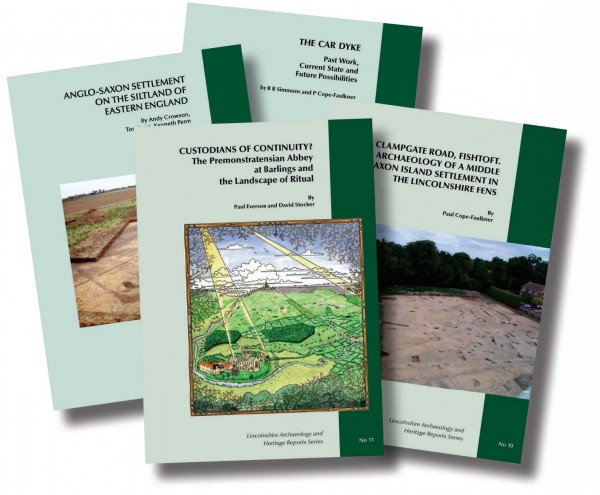
Authors: B.B. Simmons and P. Cope-Faulkner
Published by: Heritage Trust of Lincolnshire
Review and assessment of all data relating to this 92km-long Fen Edge watercourse.
226 pages; 18 black and white plates; 76 figures; 9 tables
Paperback; 297 x 209 mm (A4)
ISBN: 0-948639-39-3
RRP: £19.95 plus £3.00 P&P
Study of the Car Dyke has been approached in three ways:
1. Compilation of data from previous surveys and excavations;
2. Definition of the monument and its setting in the archaeological landscape;
3. Comparison of the physical state of the monument at present with earlier surveys to provide an assessment of change through time.
The combined data includes the latest cropmark information from 0.5km either side of the entire 92km length along with all of the Historic Environment Record information. Crop marks show the Car Dyke cutting ancient settlements and field ditches while other cropmarks appear to respect the line of the monument.
A new 'walkover' survey describes the current condition and compares this against a series of surveys undertaken since 1872. The importance of the Car Dyke as a landscape feature over time is assessed and the results of a section through the dyke at Helpringham is reported. Brian Simmons considers the capabilities of the Romans to construct such a monument by examining canals and watercourses described in the classical literature.
Is it Roman? What is it for? The up-to-date evidence is presented in this volume.

A summary of the results of ten excavations on sites on the Fenland of Norfolk and Lincolnshire.
| View Publication Details |
Lincolnshire Archaeology and Heritage Report Series: No 7
Authors: A Crowson, T Lane, K Penn and D Trimble
ISBN: 0–948639–44–X
RRP: £25.00 plus £4.50 P&P
The Fenland Management Project targeted a representative and vulnerable group of sites in the former wetland of the Wash Fenlands for management-driven excavation. Ten of these produced evidence of the precocious use of the Fens and their subsequent colonisation during the Anglo-Saxon period. Through excavation and environmental sampling, the sites revealed aspects of a diverse and thriving siltland society and economy, as well as attempts to control the challenging Fenland environment.

Celebrating the achievements of an outstanding field archaeologist, David Hall. Included are papers reflecting areas of archaeological interest.
| View Publication Details |
Essays in Honour of David Hall
Lincolnshire Archaeology and Heritage Report Series No.5
Author: David Hall
WARP Occasional Paper 17
Published by Heritage Trust of Lincolnshire and WARP
Edited by Tom Lane and John Coles
150 pages; 11 black & white photographs; 46 figures; 9 tables
Paperback; 297 x 209 mm (A4)
ISBN: 0-948639-35-0
RRP: £15.00 plus £3.00 P&P
This volume celebrates the achievements of an outstanding field archaeologist, David Hall.
Included are papers presented at a special conference in David's honour held in May 2000, along with others specially commissioned. All reflect the areas of archaeological interest of this intuitive and indefatigable fieldworker.
Fens and Fields given particular prominence. As the first of the Fenland Project Field Officers, David Hall devised the methods used on the survey. Within this volume David's Fenland interest is reflected in articles by Bob Silvester (Some Early Maps of the Fens), Christopher Evans (Metalwork and 'Cold Claylands'), Robert Van de Noort (The English Heritage Wetland Surveys in Retrospect), Bryony Coles (Fenland Beaver) and Rog Palmer (Homes for Peat Diggers?).
Some of David's wider landscape interests are addressed by Francis Pryor (The Welland Valley as a Cultural Boundary Zone), Brian K. Roberts (Woods, Fens and Roads) and Tom Lane (Reconstructing Lincolnshire Landscapes).
Medieval Fields, the study of which has brought David international recognition, are examined here by Stephen Rippon (Infield and Outfield) while John Hutchings (Archaeology and Colour Science) touches on just one of the many other varied interests of this most scholarly and practical of archaeologists.
Finally, John Coles and Paul Martin respectively, review the impact that David's work has made on the archaeology of the Fenland and of Northamptonshire.

Prehistoric and Romano-British Salt Production in the Fenland. Reports on three major excavations conducted as part of the Fenland Management Project.
| View Publication Details |
Lincolnshire Archaeology and Heritage Reports Series: No.4
Edited by T Lane and E L Morris
Heritage Trust of Lincolnshire with the aid of a grant from English Heritage
ISBN: 0-948639-32-6
RRP: £22.50 plus £7.50 P&P
This volume contains reports on three major excavations (at Cowbit, Lincolnshire, Morton, Lincolnshire and Middleton, Norfolk) conducted as part of the Fenland Management Project. The sites are all concerned primarily with salt-making and between them they span the Iron Age to Late Roman periods. Additionally, the volume examines the briquetage from six other Fenland sites.
This detailed work has enabled the compilation of a much needed type-series for briquetage, which it is hoped will be useful in describing the material from all coastal salterns.
Also contained within this volume is a re-assessment of the landscape context of the Fenland sites, an examination of the importance of slat production to the Fenland communities and recommendations for further areas of research in this subject.
Major contributers include:
- Tom Lane
- Dale Trimble
- Andy Crowson
- Elaine L Morris
- Sarah Percival
- Andrew Crosby
- Peter Murphy
- Mike Godwin
- Patricia Wiltshire
- Umberto Albarella
- Rowena Gale
- Charles French
- David Knight
- Barbara Precious
- Margaret Darling

A large part of the Fenland of Eastern England was the subject of a major programme of fieldwalking. Summaries of results (41 of 2500 sites).
| View Publication Details |
Lincolnshire Archaeology and Heritage reports Series No.3
Edited by A.Crowson, T.Lane and J.Reeve
Heritage Lincolnshire and Fenland Management Project 2000
ISBN: 0–948639–31–8
RRP: £14.50 plus £4.50 P&P
During the 1980's a large part of the Fenland of Eastern England (the country's largest former wetland) was the subject of a major programme of fieldwalking. Following publication of this work, partial excavation of 41 of the 2500 sites discovered during the field survey was carried out for the purpose of assessing their current condition and potential for their preservation and future management. Ranging in date from the Neolithic to the medieval period, the sites included settlements and burials, along with roads, canals and sites engaged in specialised activities such as salt-making. Written prior to final analysis, this report summaries the preliminary results of all 41 excavations.
Since 1973 English Heritage has supported surveys and excavations in the wetlands of England. The first of the major surveys was in the Somerset Levels from 1973 to 1987. This was followed by successive Fenland Projects from 1976 to 1996, the North West Wetlands Survey from 1990 to 1998 and the Humber Wetlands Project from 1992 to 2003. All of these major surveys have created, or will create, a comprehensive record of the archaeology and ancient environments of the lowland wetlands of England and these have been documented on a series of detailed and synoptic volumes.
Between 1991 and 1995 the Fenland Management Project investigated a selection of sites based on the results from the earlier Fenland Survey. The 41 sites in the programme were selected on a basis of the non-statutory criteria employed to select sites for scheduling and on their potential to clarify management options for different types of site. Considerable debate ensued on the best way in which the results of the field programme might be published. Eventually a four tier programme was agreed:
1. Individual site publication in national/regional/period journals;
2. Thematic volumes to be published in monograph form;
3. Thematic studies on academic issues raised by the investigations;
4. A summary volume to publish in outline details of all sites.
The scope of this summary volume therefore includes the basic data on all sites in the programme and brief summaries on the main result - some in advance of further analyses. It was felt that an early publication of the results was essential for archaeologists in East Anglia and Lincolnshire, who would otherwise have to wait some time before the completion of the integrated publication programme. This volume is therefore a work of reference for those who need it either for management or research purposes.
Dr G J Wainwright
Principal Archaeologist English Heritage

Results of a detailed and comprehensive archaeological and historical survey of Ropsley & Humby in 1979.
| View Publication Details |
Lincolnshire Archaeology and Heritage reports Series No.2
Author: T. W. Lane
Heritage Trust of Lincolnshire with the aid of a grant from English Heritage
ISBN: 0–948639–14–8
RRP: £17.95 plus £2.00 P&P
This attractive volume presents the results of a detailed and comprehensive archaeological and historical survey of Ropsley and Humby in 1979.
The Survey revealed the development of a parish, which straddles limestone heathland and boulder clay terrains. The results of the survey indicate how the landscape has been used, how that use instigated changes within it, where settlement occurred, and for what purpose. Much of the pre-historic activity was confined to the heathland but with some suggestion that the clayland was used for burial of the dead.
By the Roman period settlement had shifted and the junction of heath and clay became the preferred zone. For the medieval period, reconstruction of the landscape was achieved through the integration of documentary and botanical evidence with the results of archaeological field survey.
The fieldwork was funded by the Manpower Services Commission and the publication of the report (the second in the Lincolnshire Archaeology and Heritage Reports Series) was grant-aided by English Heritage.

Excavation of a complex Bronze Age burial mound. One of a group discovered during fieldwalking conducted as part of the Fenland Survey.
| View Publication Details |
Lincolnshire Archaeology and Heritage Reports Series No.1
Authors: Dr. Charly French
ISBN: 0–948639–13–X
RRP: £19.95 plus £2.50 P&P
The excavation of a complex Bronze Age burial mound is described in this volume. The monument is located in the Lower Welland Valley in Lincolnshire and is one of a group discovered during fieldwalking conducted as part of the Fenland Survey.
Dr Charly French, who directed the excavations, explains the history of the monument, detailing how the barrow was re-used and modified over a period of around 500 years. The earliest grave at the site dates to around 2000BC and took the form of an oval pit containing the remains of a very young child placed inside a hollowed out log coffin. A mound was constructed over this burial and some 100–200 years later two adult burials were placed in the monument.
Later in the Bronze Age a series of cremations were inserted into the barrow, some of which were buried inside bucket shaped pottery urns. The excavations have revealed how the mound incorporated timber built palisades which may have served to mark out the monument in the landscape or were used in funerary rituals at the site.
This volume provides a fascinating insight into how the dead were treated in Bronze Age Lincolnshire. Construction of these monuments must have required considerable resources and manpower, reflecting the powerful influence of the ancestors in prehistoric society.

Archaeological discoveries made during the Fenland Project fieldwalking survey.
| View Publication Details |
The Fenland Project No.8
East Anglian Archaeology Report No.66
Author: Tom Lane
ISBN: 0–948639–11–3
RRP: £11.99 plus £2.00 P&P
The archaeological discoveries made during the Fenland Project fieldwalking survey of the northern fen edge in Lincolnshire are described in this volume.
As with the survey of the southern fen edge, many new sites were discovered and a new understanding of the history of occupation of this area of the fens has emerged.

The survey discovered hundreds of previously unknown archaeological sites. Detailed findings, illustrations and maps.
| View Publication Details |
The Fenland Project No.5
East Anglian Archaeology No.55
Authors: Tom Lane and Peter Hayes
ISBN: 0–948639–07–5
RRP: £19.99 plus £3.50 P&P
The Fenland Survey discovered hundreds of previously unknown archaeological sites in the Lincolnshire Fenland. Some of these date to Iron Age and Middle Saxon times, periods when it was previously thought that occupation was impossible in the Fens due to marine and freshwater flooding.
This extensive survey enabled the mapping of archaeological sites against a detailed understanding of the changing Fenland environment. The volume details the finding of the survey and includes many informative illustrations and maps.
Where possible APS seeks to publish significant results from its fieldwork and post excavation research. Major sites are published in the in-house Lincolnshire Archaeology and Heritage Reports Series and staff also contribute to journals where appropriate.
Copies are available from info@apsarchaeology.co.uk
Having specialist in-house design and illustration staff helps disseminate the information clearly and effectively and to our timetables. Have a browse at our titles for sale.